
A winter border
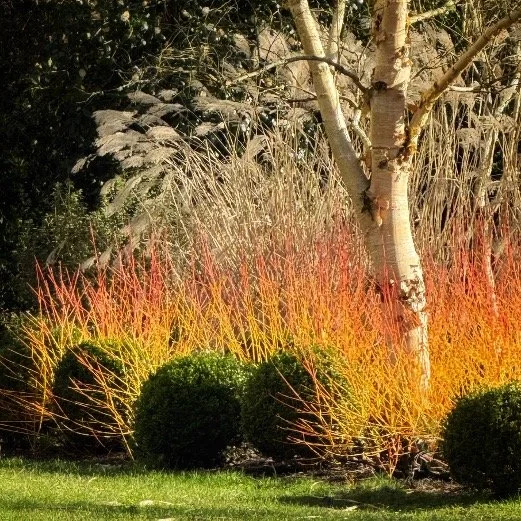
A border in the Sir Harold Hillier Garden
Design analysis - practical and ecological factors
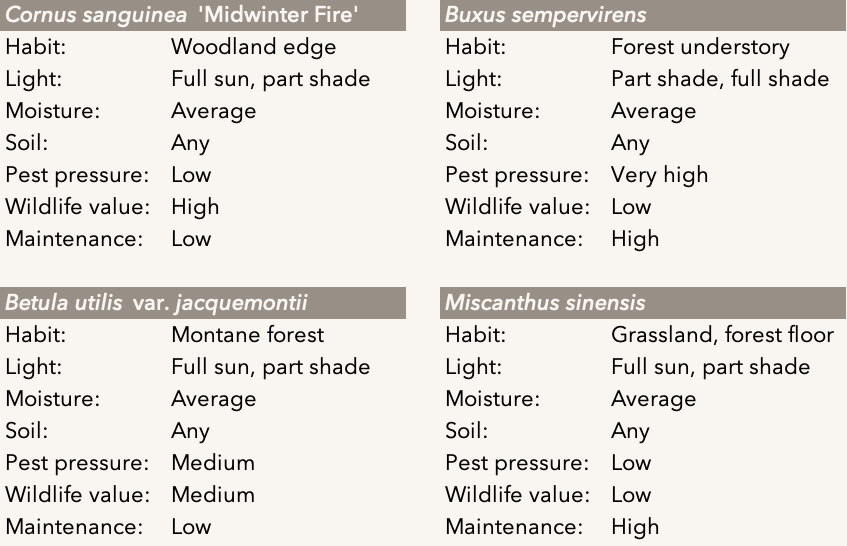
Plants have been selected from comparable habitats, albeit from different parts of the world. The main concern from this perspective is Miscanthus sinensis, which has a lower tolerance for shade than the other plants in the association.
The selection of Buxus sempervirens made sense when the border was originally planted. Pest pressure in recent years makes this a high maintenance and environmentally unsustainable choice; alternatives should be considered.
Although Cornus sanguinea has significant value to wildlife, and the dead stems of Miscanthus sinensis may shelter overwintering insects, an opportunity has been missed to provide support to wildlife in this area. This should be taken in context of the overall garden, where many other plants provide such winter support.
Design analysis - aesthetics
Overall design concept
This border sits within the winter garden at the Sir Harold Hillier Gardens, and is designed primarily for its aesthetic appeal to the public at large during the cold season. As such, the design intent is to appeal to a mass audience with bold, striking contrasts. In this, it is extremely successful, forming a focal point for the whole of the winter garden, viewed from many different perspectives. Similar planting has been used (perhaps overused) in many gardens elsewhere, but can overwhelm a smaller or less public space, where a more subtle, refined plant palette may be more successful.
Contrast and harmony
Although bold contrast is a key design intent, this alone could be jarring, and harmony is also needed to provide balance. The selection of a simple palette of plants allows a very simple contrast to dominate: that of the clipped, round, dark green form of the Buxus sempervirens with the upright, bushy, bright red/orange form of the Cornus sanguinea. Complementary colours, with red advancing and green receding (particularly when dark), these are well balanced; dense blocks of green against a smaller number of loose open red forms. The white of the Miscanthus and Betula, together with planting in the border behind (unidentifiable from its winter form) provide a backdrop for this display, but also provide the much needed harmony; their upright forms complementing one another, and also that of the Cornus.
Rhythm and movement
The composition of the planting has a pleasing sense of rhythm and balance. The two Betula strongly define the space without dominating it; more than two would shift the focus to the trees and their repetition and away from the rest of the planting. The Buxus balls are shaped symmetrically, and rhyme in their placement rather than repeating, providing dynamism and a sense of movement; and yet at the same time providing robust solidity against the actual movement of the softer winter stems of the Miscanthus.
Proportion and balance
The planting makes very good use of proportion, taking into account not only the size of the plants, but also their colour, texture, mass and density. Small, dense forms dominate the foreground, but are balanced by slightly taller, brighter forms in the middle of the border. These in turn are backed by much taller, but softer planting at the back of the border. The more forward positioning of the two Betula pulls the eye back forward. The overall effect is to maintain visual interest.
Wider context
The wide grassy path in front of the planting provides further visual balance and harmony of colour; this could be considered part of the association itself. The planting is set within a four acre winter garden, and forms a strong focal point for this entire space. At the same time, nearby planting, particularly larger trees and more subtle colours, helps to tone down the sheer visual impact and balance the overall space.
Off season interest
This border is at its best in winter. However, the choice of plants and their positioning will help to ensure interest, albeit significantly less dramatic, in other seasons. The solid form of the Buxus, and the stems of the Betula will hold their form year round. In spring, the Miscanthus will be cut back, revealing the garden beyond (this will be the least effective season as the sense of balance and proportion will be lessened). In summer, new growth will restore the overall form, with complementary shades of green in the foliage. Then in autumn, the flowers of the Miscanthus will light up against the reddening foliage of the Cornus and yellowing leaves of the Betula.
Design recommendations
Although highly successful in achieving its design intent, a number of recommendations are worth considering.
Replacement of Buxus sempervirens
The single biggest design decision that will need to be made in respect of this border is the future of the Buxus sempervirens. Although currently broadly healthy, this is unlikely to remain the case without a very high maintenance regime, including spraying with insecticides. Environmentally unsustainable, and a potential health risk in a public garden, this is not a practical option. As such, alternative species (such as Lonicera ligustrina var. yunnanensis ‘Maigrun’, which is now being used widely in the box replacement trial garden at RHS Wisley) will need to be chosen.
Older images found online suggest that box balls were once placed throughout the border, but have gradually succumbed to the predations of the caterpillar. These appear to have been replaced by additional Cornus sanguinea. Whilst this has been effective, continued replacement in this manner will fundamentally change the character of the area.
Reducing visual dominance
The currently planting is striking in its contrasts, and in that sense is highly successful in achieving its design intent. A strong point of visual focus throughout the winter garden, it is perhaps too strong, visually dominating even from a distance. Reducing the contrast would be one option, perhaps by reducing the quantity of Cornus sanguinea in use, albeit this might imbalance the overall planting. An alternative would be to consider extending the surrounding planting, partially obscuring the view of this association.
View from the rear
The plant association is clearly designed to be seen primarily from one side. When seen from the rear, it is less successful, with the Cornus sanguinea becoming visually dominant. Addressing this issue would be fairly straightforward, with the placement of a small number of additional clipped balls on this side.
Depth of planting
The planting is fairly long and thin, meaning that visitors to the garden face off against one another across it from the paths on either side. Deepening the planting area would allow a greater sense of separation, and would allow a larger drift of Miscanthus, meaning that the planting would no longer need to rely on the border behind to create the sense of contrast at its narrower end.
Other images
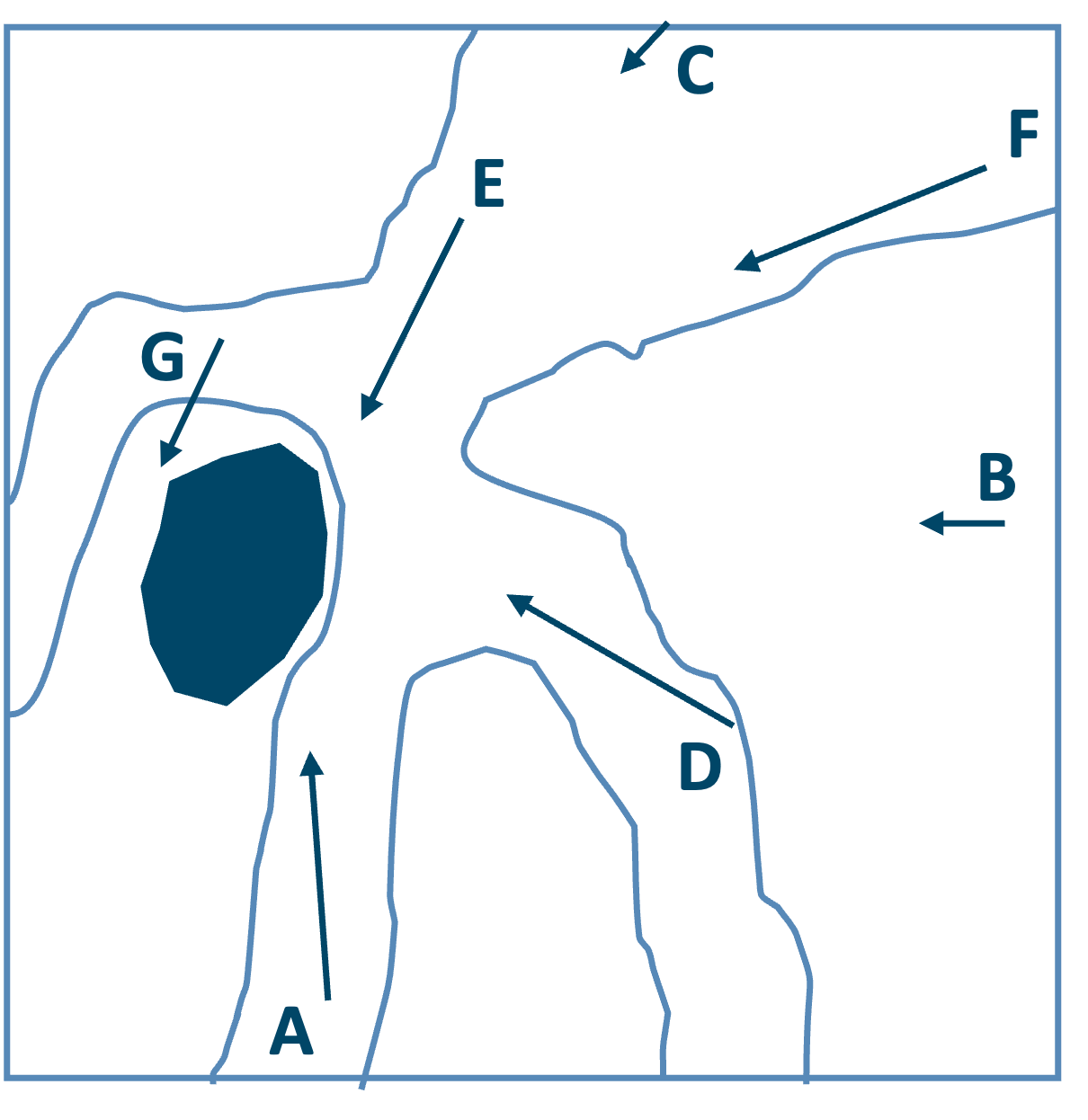
A schematic showing the position of the winter border in context (letters reference images).
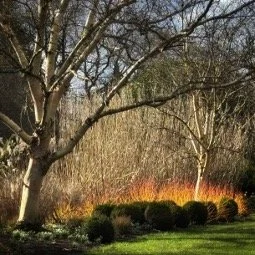
A. Approaching the border from the entrance to the winter garden.
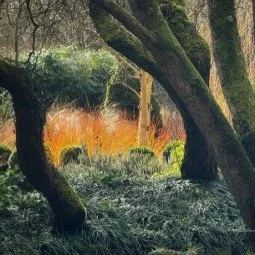
B. View of the border through the moss-covered trunks of trees (set in a carpet of Ophiopogon planiscapus).
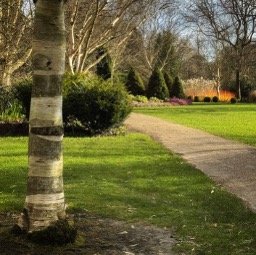
C. Looking back to the border from the far end of the winter garden.
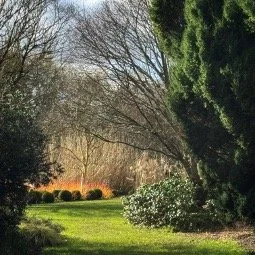
D. Approaching the border from the entrance to the winter garden by a different route.
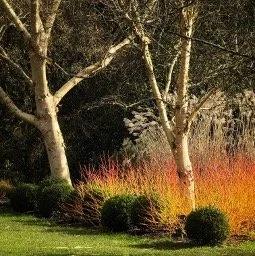
E. View of the border from the far side of the entrance to the winter garden.
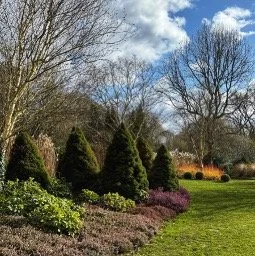
F. The border in the wider context of the winter garden.
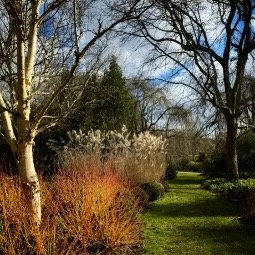
G. The border seen from the rear.