
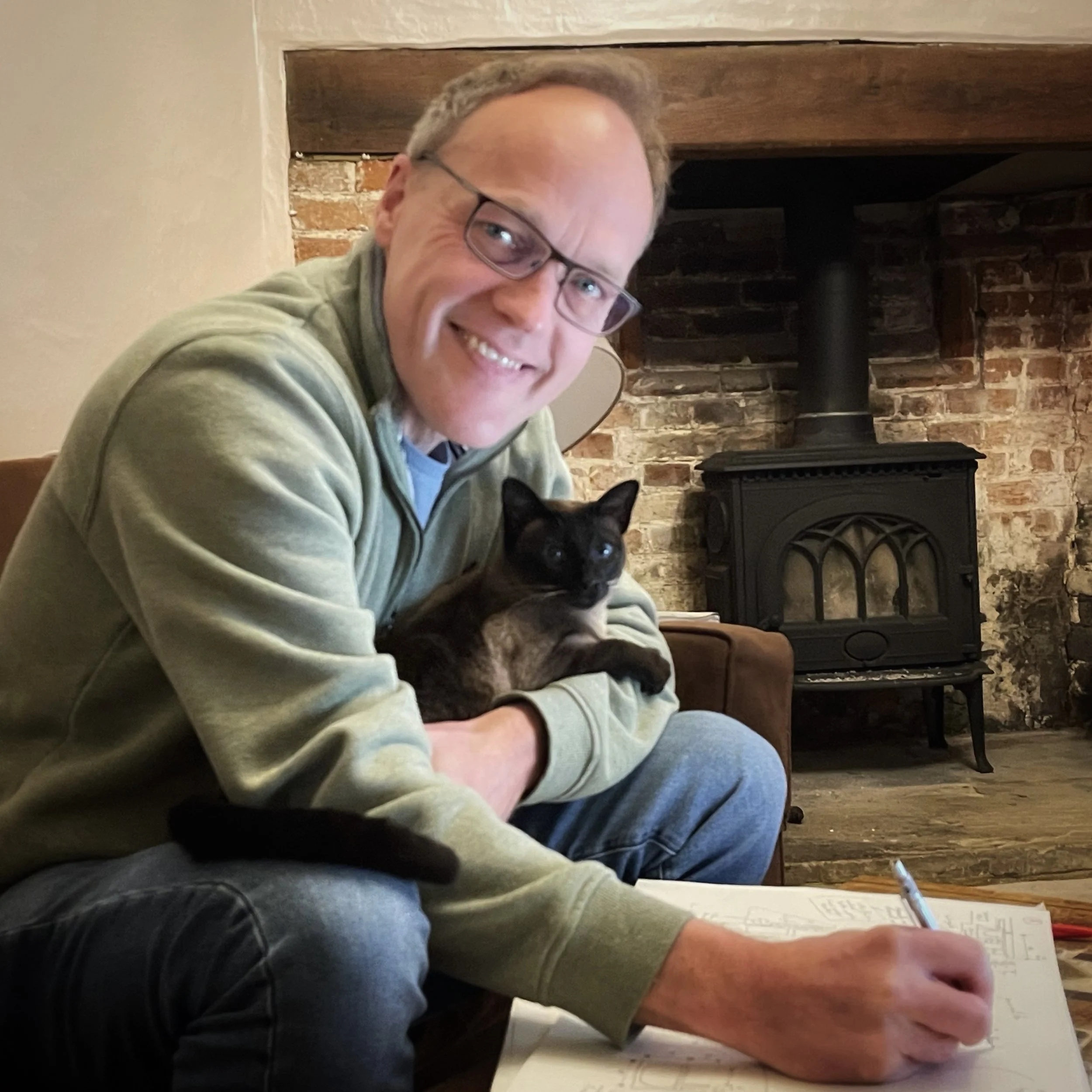
I’m Duncan.
I help people with substantial country properties turn their land into landscapes that become part of how they live.
I bring an unusual combination of experience to that work. I spent more than twenty years helping senior people understand complicated problems and make important decisions, and I have since immersed myself in horticulture and garden design. I am endlessly curious, enjoy getting to the bottom of things, and tend to look for the connections between them.
What matters to me is using that way of thinking to help someone make sense of their own landscape. To understand what they want from it, what the land has to offer, what the possibilities are, and which choices are worth making. I enjoy exploring those questions with a client, working through the implications together and gradually turning an initial idea into something that feels right for them.
I take professionalism and discretion seriously. I am used to working with people who expect a high standard of judgement and delivery, and I understand that a landscape represents a significant investment of both money and time. You should be able to trust me to do what I say I will do, to tell you when I do not know something, and to find out when it matters.
If you would like to know more about the person behind this approach, there is rather more to the story…
I like to understand things
I am a garden designer, but garden design is only the latest expression of something that has been part of me for as long as I can remember.
I am curious. I like difficult questions, complicated subjects and the satisfaction of eventually understanding something that initially seemed obscure. When something catches my interest, I tend to go down the rabbit hole. I read, investigate, question what I have been told and look for the connections between things. I am, in other words, a bit of a nerd.
That has taken me through mathematics and operational research, more than two decades in international banking, strategy, risk and innovation, writing a book about banking, and eventually into horticulture, landscape and garden design. The subjects have changed considerably, but the way I approach them has not. I want to understand things properly, to distinguish what I know from what I think I know, and to understand enough of the underlying principles to make sensible decisions when circumstances change.
I approach landscape design in much the same way. I want to understand the people I work with, the way they live, what they value and what they want their landscape to become. I want to understand the land itself, its character, opportunities and constraints. And I want to understand the decisions that connect the two.
I do not expect to know the answer to every question when I begin. I do expect to be able to work out what I need to know, find the right information or expertise, and use it to reach a considered conclusion.
A rather long way into garden design
My route into landscape design has been unconventional, although there is more continuity to it than might appear at first.
After university I intended to become an academic mathematician and began a PhD at the California Institute of Technology. Six months later I realised that academic research was not for me. I returned to the UK, completed a Master's degree in Operational Research and joined HSBC.
What followed was more than twenty years of international banking: moving countries and working across different businesses and functions, eventually taking on senior roles in strategy, risk, control and innovation. I worked with senior executives on difficult problems, developed strategies, led major initiatives and was responsible for decisions with significant consequences for businesses and the people within them.
It taught me to be comfortable with complexity. Complicated problems rarely have simple causes, and apparently sensible decisions can have consequences several steps removed from the original choice. I learned to look beyond the immediate problem, understand the wider context and work out what really mattered before deciding what to do.
I also learned a great deal about people. Important decisions are rarely purely analytical. They involve priorities, preferences, uncertainty, constraints and competing things that matter to the people involved. Good advice is therefore not simply about having an answer. It is about understanding the situation well enough to help someone make a decision they can be confident in.
When I left banking in 2020, I thought about how I might apply the experience I had accumulated in a different setting. At the same time, I asked myself what I actually wanted to spend the rest of my working life doing.
The answer took some time.
By then I had become increasingly interested in gardening. It had started rather badly. When my family and I moved into a 500 year old farmhouse in Surrey in 2016, the garden was largely neglected. We cleared it, built some paths and borders and bought plants that looked nice. I then watched many of them die.
Rather than simply trying again, I wanted to understand why. I started reading about growing conditions, soil, water, light and nutrition. The more I learned, the more I realised how little I knew, and the more interesting the subject became.
Gardening turned out to contain an extraordinary amount of what I enjoy. There is intellectual problem solving in design, the academic depth of subjects such as plant physiology and soil science, creativity and aesthetics, physical work and observation. There is also the pleasure of watching something change over time, and the quieter benefits that come from spending time outside.
It connects with my other interests too. Photography has taught me to look closely at composition, proportion, depth, light and the way a view changes from different positions. Even technical origami appeals to the same part of my brain: structure, geometry, precision, creativity and the challenge of working out how something complex can be made from something simple.
The more I learned about gardening, the more I wanted to learn. A certificate in horticulture led me into botany, plant physiology and soil science. I visited gardens, studied plants and started looking at landscapes differently.
As I explored where my interests and experience might take me next, I began to look more closely at how I might work professionally with gardens and landscapes. Conversations with people working in different parts of the industry helped me understand the possibilities, and I became increasingly interested in the point at which horticulture, design, problem solving and the way people use places come together.
I decided to develop my knowledge formally and enrolled at the London College of Garden Design, where I completed the Garden Design Diploma with Distinction.
This was a field in which I could bring together many of the things I enjoy: understanding complex subjects, solving problems, thinking creatively, working with detail, and ultimately making something tangible that people can live with and enjoy.
I had found the next thing I wanted to spend my time understanding.
Understanding rather than simply knowing
One of the things I have come to value most is the difference between knowing something and understanding it.
You can learn that a particular plant should be pruned at a particular time of year. That is useful knowledge. But if you understand that it flowers on stems produced the previous year, you can understand why the timing matters. You can begin to apply the principle to other plants and other situations.
Go deeper still and you begin to understand the biological processes behind growth and pruning. That level of detail is not always necessary, but it changes the way you look at the plant. You can start to reason from what you observe rather than simply following instructions.
This is how I naturally learn. I am rarely satisfied by an isolated fact when I can understand the principle behind it. I want to know how things connect, what assumptions sit underneath them and whether the explanation actually makes sense.
That does not mean pursuing detail for its own sake. There is no particular virtue in knowing something that does not help you think or decide. For me, the value of understanding is that it allows me to generalise, question what I have been told and make my own judgements when I encounter something new.
It also means that I am comfortable saying that I do not know something. Not knowing is simply the starting point for finding out.
The person you would be working with
A landscape is personal. To design one well, I need to understand more than the physical characteristics of a site. I need to understand how you want to live, what you enjoy, how you use your time, what matters to you and what you want the landscape to contribute to your life.
That means you will probably tell me things that have little obvious connection to garden design. That is part of the point. Understanding how someone lives is often more revealing than being given a list of requirements. I need to listen carefully, ask questions when they are useful and pay attention to the things that may not initially seem important.
It also means that discretion matters. The landscapes I work on are private places, and the conversations involved in designing them are personal. I take that responsibility seriously.
I have spent much of my career working with people who expect professionalism, judgement and delivery. I know what it means to be trusted with an important decision and a significant investment, and I am accustomed to working with demanding people who expect commitments to be kept.
I will not pretend to have every answer. But I will take the question seriously. I will investigate what needs to be understood, find the information or expertise required, explain what I find, including uncertainties and trade offs, and give you advice I can justify in the context of your particular circumstances.
Ultimately, I do not want you to feel that you have been persuaded to accept my garden. I want you to feel that we have understood what matters to you, explored the possibilities properly and arrived at decisions that you are happy to own.
That is the kind of professional relationship I value. And because we may spend quite a lot of time together along the way, it helps if we like each other too.