

You never really start with a blank canvas. The land tells its history, and you have to work out which of that you want to keep, and which has no further place in the story. Cwmamliw has been used for agriculture for most of its history, and more recently as a home for a family with young children and animals, including horses. That agricultural heritage is important, reflected in the character of the land and its surroundings. Not so, the adaptation of the land to the needs of the previous owners, nor the immediate consequences of their stewardship of Cwmamliw.
We have our own aspirations for Cwmamliw, and to start putting those in place meant first stripping back those things that we felt didn’t belong. Internal fencing to create pasture for horses, an old chicken coop, play equipment for children, an abandoned, rotting wooden shed. All needed to be removed, materials saved for reuse where possible, and where not, disposed of.
The impact of time also needed to be addressed: overgrowth on the hill behind the house and in the woodlands; suckering blackthorn and self-layered willow around the boundaries; hedges that had grown out into trees…but before turning to this, we needed to see how the land behaved through the seasons, to see what grew, and how the character and atmosphere of different areas changed over time.
There is no point in our creating a landscape that we can’t maintain. We needed to be able to propagate plants, to grow them on, to store them until ready to plant them out in their final locations, to cut them back, and to compost the waste we created. We needed to store tools, pots, growing media, woodchip, stones; and be able to access these efficiently when needed. We needed access for vehicles. We needed new machinery of our own.
And we needed to start creating, rather than simply stripping things back. We needed to start planting.
Early decisions
Our initial priorities were to clean up the land, to put in place the utility areas upon which we could build our operating model, to develop our thinking about the future of the landscape, and to begin planting.
Some aspects of cleaning up could take place immediately, and would have an immediate effect; taking out the fences opened up the landscape and created an immediate sense of unity, and removing things left behind by the previous owners strengthened our sense of ownership of and belonging to the land. Others, such as removing overgrowth, would create large amounts of waste that we didn’t yet have the capacity to process without a chainsaw and a woodchipper; these we chose to defer.
The utility areas needed to be accessible for deliveries, but out of the way of the more ornamental parts of the landscape. The stone barns were an obvious place for storage and for use as workshops. Using the land beyond these for greenhouses, cold frames and nursery beds was an easy decision; as was placing the compost bays close by. However, this land was overgrown, and the greenhouse we inherited was already functional, so we chose to retain this in place for now, and to create our nursery bed temporarily on the site of the former chicken coop nearby. This can be moved to its permanent location, once we are ready to do so.
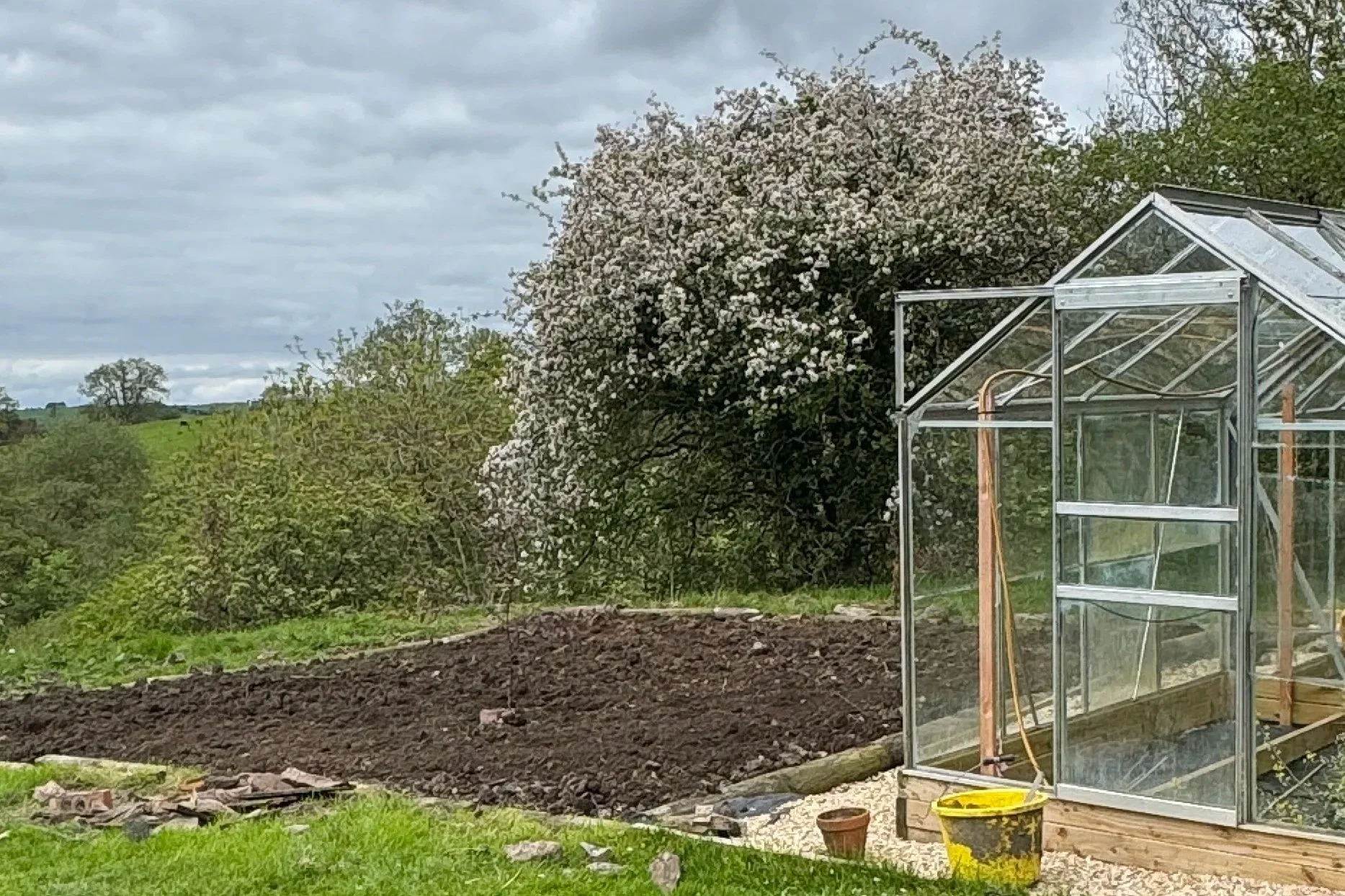
The temporary nursery bed next to the inherited greenhouse in spring 2026
We were not yet ready to translate our thinking about the future of Cwmamliw into concrete plans; we wanted the landscape to be curated more than designed, and we needed to allow our experience of living with the land to shape our thinking. That said, there were decisions we could take immediately.
We knew we wanted a productive garden, to grow food and flowers for the house. We knew this needed to be close to the house and to the utility areas, that it needed to be in full sun, and that it would have a character that would feel more domestic than the rest of Cwmamliw, so it needed to somehow stand apart. Taken together, these factors made it an easy decision to place the productive garden in the open land behind the barns. Building on this, we felt it natural to designate the nearby land in the open field as the site of our future orchard.
Beyond this, our vision was loosely defined in terms of planting areas with different growing conditions and character, flowing coherently into one another through a series of journeys through the landscape. The precise nature of those areas remained to be determined, as did the planting, but we allowed the topography of the land to speak to us as we walked around, gradually persuading us to move our thinking one way or another.
That, together with our assessment of the place itself, its soil and its microclimates, drove our first planting decisions. We covered the ground in the productive garden to kill the weeds, and planted crops such as squash and sunflowers whose roots would improve the soil structure. We planted the Japanese maples we had brought with us into the sheltered slopes where the drainage was good and where they wouldn’t be scorched by the sun and wind. And we started to source trees.
In line with our overall approach to Cwmamliw, most of the trees we bought were tiny, no more than a year, or at most two years old. Some of these could be planted out; many others needed to be grown on in containers until better able to fend for themselves. As we found other, larger trees on sale at plant fairs and in nurseries, often at significant discounts, we took decisions on each. Not so much where in the landscape they might go; more a question of how much we liked them and how strongly we felt they fit with our vision of Cwmamliw as a plant collection as well as a garden.
These larger trees needed to be planted immediately, so we began to play with their locations in our minds, considering how they might fit within, and shape, the character of each part of the landscape as they matured; as well as whether they would thrive in the growing conditions in each area. The first few trees were challenging, involving a lot of positioning and repositioning as we debated the merits of each location. As these took their places, subsequent trees could more easily be imagined in the landscape, allowing us to start putting in place some of the structure that will shape Cwmamliw as it develops.
The decisions we were taking would have long term consequences for the character of Cwmamliw as an ornamental landscape. Some of those consequences will be relatively small, the associated decisions reversible with limited cost or regret. Others are irreversible, and if the wrong decision was made, could trigger regret for many years. And some start small and can become more impactful over time.
As we made our decisions, we thought carefully about the risks involved: how they might constrain the future development of Cwmamliw, and how challenging it might be to unpick them in later years. Our initial clean up decisions bore almost no risk of regret; our decisions on the location of the utility areas and productive garden carried far more potential risk. There was also a risk in not taking decisions, of not beginning the process of transforming Cwmamliw into the landscape we want it to become.
2026 was one of the hottest, driest years on record, with temperatures above 36℃ and rainfall far below what would normally be expected. And we had planted trees without irrigation, assuming that young trees would establish themselves easily in the damp Welsh climate. Extensive watering by hand was essential, and incredibly time consuming. Already planted trees had to be returned to containers for intensive care. And still a fair number succumbed to the drought.
And although we knew we were in sheep farming country, we didn’t understand the determination with which hungry sheep, particularly those struggling to graze on the parched common land above Cwmamliw, would find the weakest point in the boundary of the land, and push their way through in their search for food. Sheep are not fussy eaters; by the time we managed to evict them and repair the boundaries with the help of our friendly neighbouring farmer, they had caused significant damage, defoliating some trees and snapping others in half as they rubbed themselves against the immature stems.
Climate change is likely to result in more heatwaves, and in longer periods of drought, and we need to be prepared for these. However, the greater threat to our planting at Cwmamliw is the winter wet, particularly the high water table. The answer is not to seek out only drought tolerant species; we will need to instead shift the majority of our planting to the autumn, to allow young trees to become more established before the summer. And we will need to be more observant of the weather conditions, intervening earlier and faster to protect our plants until they are strong enough to fend for themselves.
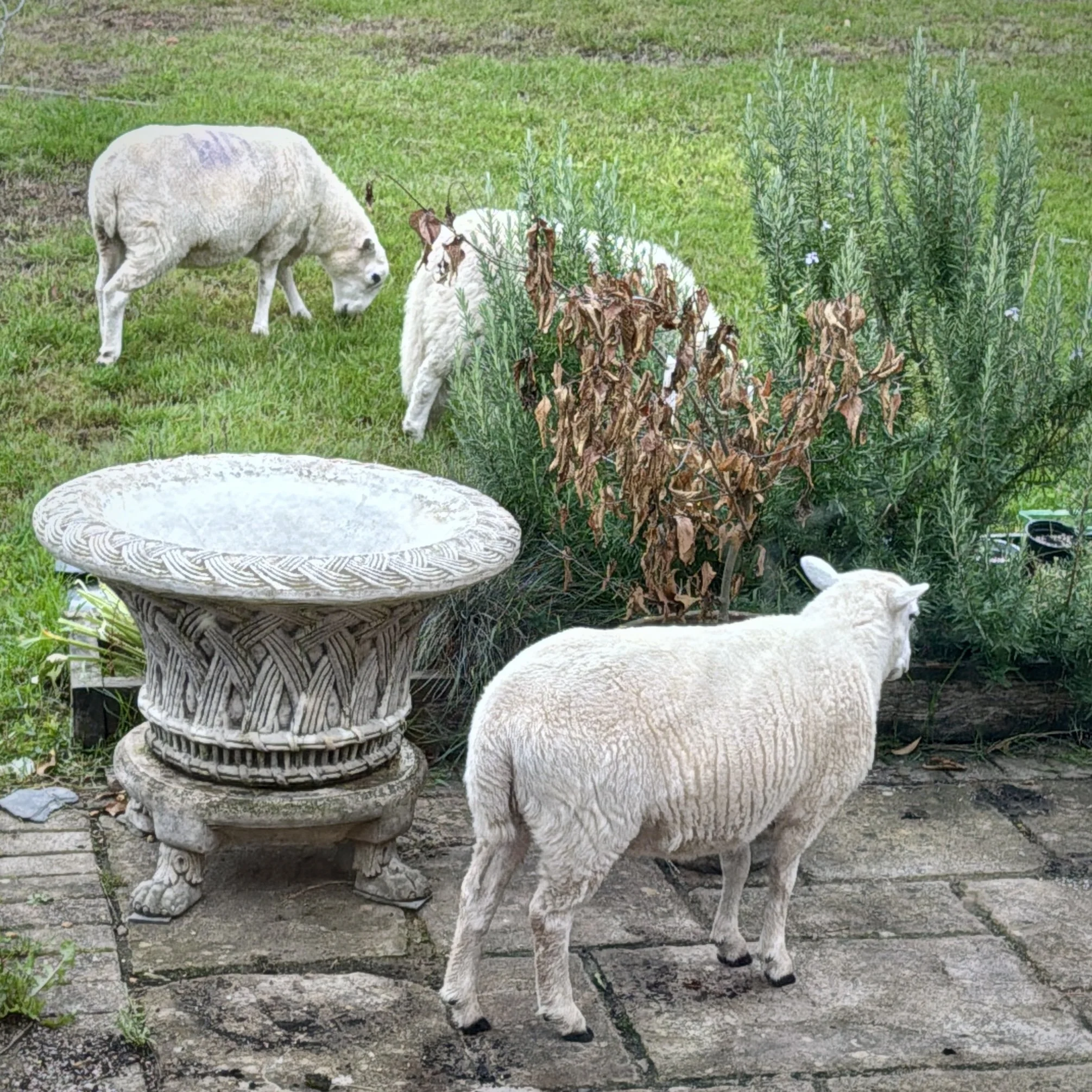
Sheep right next to the house at Cwmamliw in summer 2026
Sheep will remain a fact of life here in Wales. It is not practical for us to be able to protect all of our plants from them should they break in once more, though we may wish to put barriers around our most important ones. We need to understand and work with the farming calendar, recognising the times of year when there are more sheep nearby and when they may be hungrier and more desperate. And we need to monitor and reinforce our boundaries ahead of these times, seeking to minimise the risk of them finding their way into our land.