

Cwmamliw, like its surrounding landscape, has been shaped by agriculture for hundreds of years. The view across the valley is dominated by hills clad in fields of sheep, the shape of each defined by hedgerows and trees. The activity in these fields follows the same rhythms as it has for generations: lambing, fattening, shearing and gathering the sheep for market. The hill behind the house, common land governed by ancient rights of pasture, reflects the impact of less managed grazing, with its vegetation dominated by plants tough enough to survive the relentless activity of the sheep: bracken, gorse and sparse trees, together with grass nibbled down to almost nothing.
Cwmamliw has not previously been a garden. The existing planting is a combination of naturally occurring woodland and agricultural hedges on the boundaries, some of which have been allowed to grow out into hedgerows of trees. Its character today is largely the result of livestock farming and natural regeneration following the removal of the animals. The buildings: the farmhouse itself, the two barns, and a couple of ramshackle tin sheds also speak to its agricultural heritage. The addition of a large, almost fully glazed extension has brought the expansive view into the experience of living in the house.
Transforming Cwmamliw into a much more ornamental landscape starts from understanding the land itself: from its underlying geology and topography, through the historic impact of climate and agriculture, to the current vegetation and how this would evolve if left alone.
Reading the landscape
Cwmamliw sits on a bedrock of slate and mudstone, covered by heavy clay subsoil. Such soils are usually slightly acidic, highly fertile, but seasonally wet, with somewhat impeded drainage. The soil at Cwmamliw, however, has been further shaped over time by the effects of climate and farming.
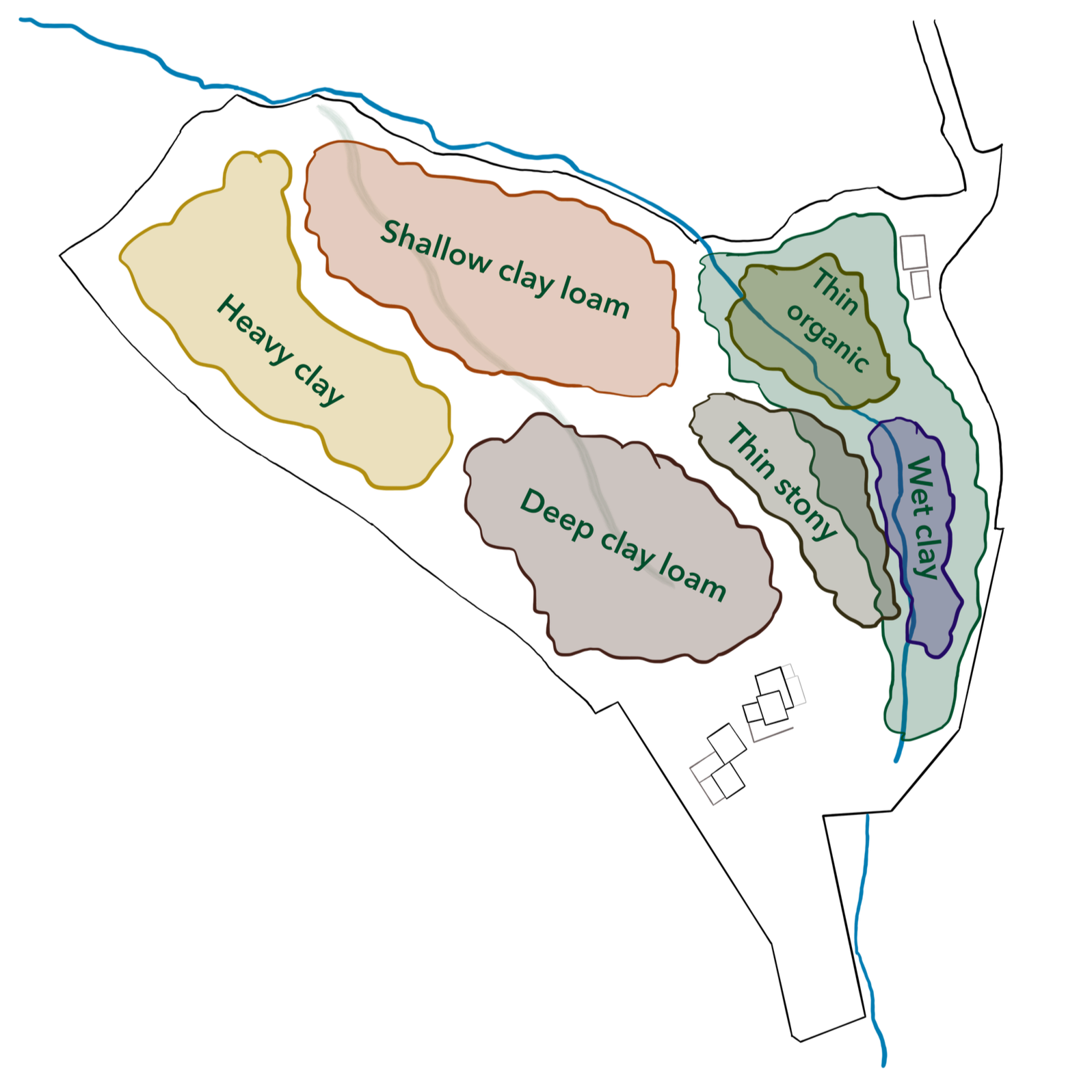
Indicative map of topsoil variation at Cwmamliw
The upper part of the open field has fairly deep, clay loam topsoil as a result of generations of livestock producing and trampling large quantities of organic matter into the ground. Their movement across the land has also compacted the soil, meaning that this part of Cwmamliw holds water too well, becoming waterlogged in winter; aided and abetted by a very high seasonal water table. Further down the slope, the topsoil becomes shallower, with higher proportions of clay; its characteristics driven by the slow accumulation of decaying vegetation rather than the digestive processes of sheep. The steeper slopes are again different. On these, the movement of water over centuries has eroded even the subsoil, resulting in loose fragments of slate and mudstone held together by dust and the roots of sparsely growing grasses.
The woodland is again different, its soil characteristics driven instead by the presence of trees and the movement of water running off from the surrounding hills. The upper part of the woodland has little topsoil, with wet, boggy clay by the stream side, and the same fragmented slate and mudstone higher up. In the lower part of the woodland, alder and willow trees appear to have drawn much of the excess moisture from the ground; soil here consists of the same heavy clay, now dry, covered in a thin layer of decaying organic matter.
Were it not for Cwmamliw’s sheltered location, wind and rain might have further eroded the topsoil. As it is, with Cwmamliw nestled into its own microclimate, the soil has developed significant variation across the land that will both enable and constrain the diversity of plants that will thrive; both plant selection and plant location will drive success or failure.
The existing vegetation reflects both the underlying soil characteristics and the agricultural use of the land. The field has remained open land due to the pressure of grazing, which has prevented the establishment of more than grasses and grassland wildflowers. The removal of livestock has however already led to the encroachment of nettles and brambles, reflecting the underlying fertility of the soil, and of potentially invasive trees such as blackthorn, willow, ash, alder and oak. The pattern of vegetation across the land shows the variety of ground conditions, with different types of grass in wetter and drier areas, along with varying wildflowers, from docks to meadowsweet.
In the upper woodland, the damp conditions have resulted in lush undergrowth, dominated by semi-aquatic plants such as water mint, hemlock water dropwort and false watercress. Away from the boggy areas, but where the soil remains damp, creeping buttercups form dense carpets. Further downstream, the drier conditions together with nutrient capture by the large, mature trees has resulted in large areas of bare soil. Nature is not to be thwarted, however, and saplings of holly, hawthorn and ash are beginning to establish themselves, with brambles beginning to invade from more congenial areas nearby.
The woodland shows the impact of limited management over time. Mature trees are veteranising, their stems sprouting fungal fruiting bodies, their branches dripping with lichens and mosses, and their bases surrounded by suckers and epicormic shoots. There are very few younger trees in the woodland, meaning that there is no natural process of succession in place as the older trees begin to fail. Left to its own devices, it would rapidly become a tangled mess of shrubby semi-woodland, taking many years for a new generation of mature trees to establish.
The character of the landscape
The defining character of Cwmamliw as an ornamental landscape is its scale, and the even bigger scale of its surroundings. Weather can be seen moving across it long before it arrives. Mist separates the visual layers, at times advancing them, at times forcing them into retreat. Frost and snow transform the colours of the land, reflecting those of the sky above.
The views out across this landscape, particularly from the house, are dramatic and all-encompassing; these must be retained as the landscape develops, though planting can be used to shape, refine or enhance them.
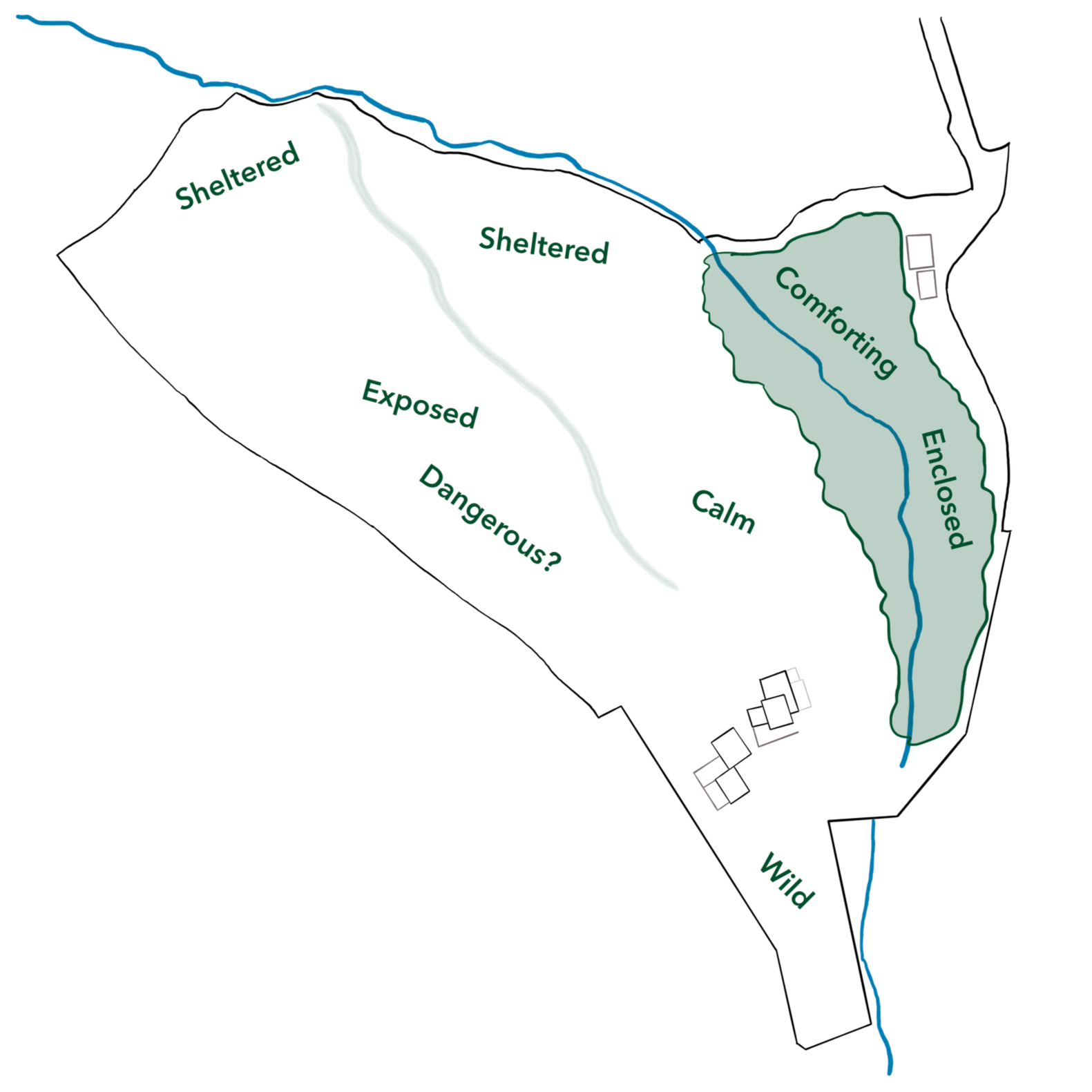
Illustrative landscape character by area at Cwmamliw
Exploring the land further, different areas have distinct characters. The woodland feels enclosed and comforting. The steep land behind the house feels wild. The centre of the open field can feel almost dangerously exposed. The lower land at the far end feels sheltered. The sounds of farming interrupt the calm, with sheep bleating and tractors working; except in the woods, where the sound of the stream is the dominant factor.
Working with the landscape
The essential character of Cwmamliw and its setting are what drew us to it in the first place, and why we fell in love with it. As we work to transform its land into our own ornamental landscape, it is critical that we retain this essence. We need to bring the land back under control, but not to impose too strong a sense of control over it.
The existing character of the woodland is so strong that we need to build on this, cutting back overgrowth and allowing the trees and the stream to breathe; and establishing succession through our own selection of new plants. We also need to restore the layers of the woodland, adding in ornamental, but not overly gardened, shrubs and woodland perennials.
The open areas present a different challenge. Here, we need to impose structure on the land, reducing the sense of exposure, and creating journeys through the landscape that feel welcoming and intimate; without losing the sense of scale and the incredible views.
The sheer scale means that the practicalities of this are different to those of a smaller garden. At Cwmamliw, the weeds we concern ourselves with are trees and shrubs. The tools we need are tractors, diggers, and chainsaws; as much as mowers, spades, and secateurs.
Time too is a key factor. We need to plan for a succession of landscapes. Many of the larger trees we plant now will take decades to reach maturity. In the interim, we need to plant smaller, faster growing specimens that will provide interest and character in the shorter term; accepting that these will need to be removed, or will be shaded out, as time passes. Similar considerations apply to the rest of our planting decisions; as the planting develops, it will gradually change the structure and characteristics of the soil, and alter the level and timing of light reaching the ground.
The starting point for our decisions is not simply what we would like to put where, but what the place can support, what we want the landscape to become, and how the physical conditions will change and interact over time. The position of a tree will affect a view, a journey, growing conditions and the character of a space; and once fixed will have consequences for the position of other trees and plants. These implications accumulate over time, so the decisions we make need to work both for the land as it is now, and for the landscape we want it to become. We will only see the full consequences many years from now.