
Introduction
Cwmamliw is my home in mid-Wales. Here, my partner and I have our own substantial piece of land, which we are transforming into a landscape that is fundamental to how we want to live the next phase of our own lives.
Cwmamliw is a deeply personal project. The decisions we make as we develop our landscape reflect our own characters, preferences and interests, as well as our own circumstances and the resources we have available to us. Each decision we take not only has an immediate impact on our everyday life, but also influences and constrains the options that are available to us in the future development of Cwmamliw. We have to decide what matters, what does not, what to do, what not to do, and how to balance these competing considerations and constraints.
Cwmamliw is a curated landscape, not a designed landscape. It is a place where we can experiment, play, learn and understand; a place that will evolve organically over time.
Your land will be very different to Cwmamliw. Your aspirations for your landscape will be very different. The decisions you take will be very different. But the fundamental approach behind those decisions will be the same. I understand from personal experience what it means to inhabit, use, manage and maintain a large landscape.
The place
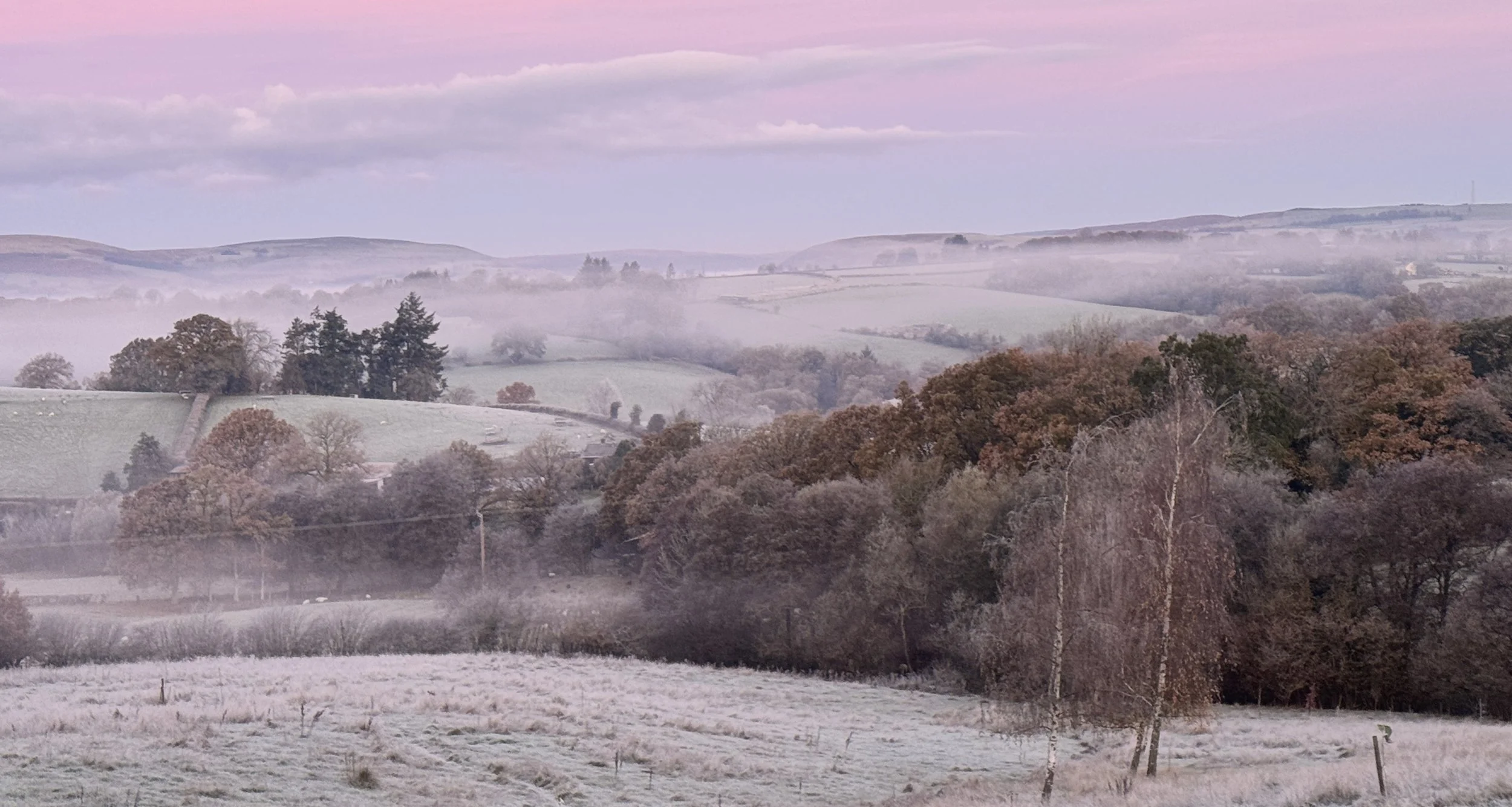
Cwmamliw is in a sheltered hillside location in mid-Wales. Embraced from the northeast to the northwest by the hill itself, and with wooded areas to the north and south, its primary exposure is to the southwest. In this direction, it has expansive views out across a valley towards the Cambrian mountains.
The hill itself is common land, grazed by several thousand sheep under ancient rights. The surrounding area is a patchwork of mostly sheep farms. The only buildings visible belong to these farms, with few other signs of human habitation in view.
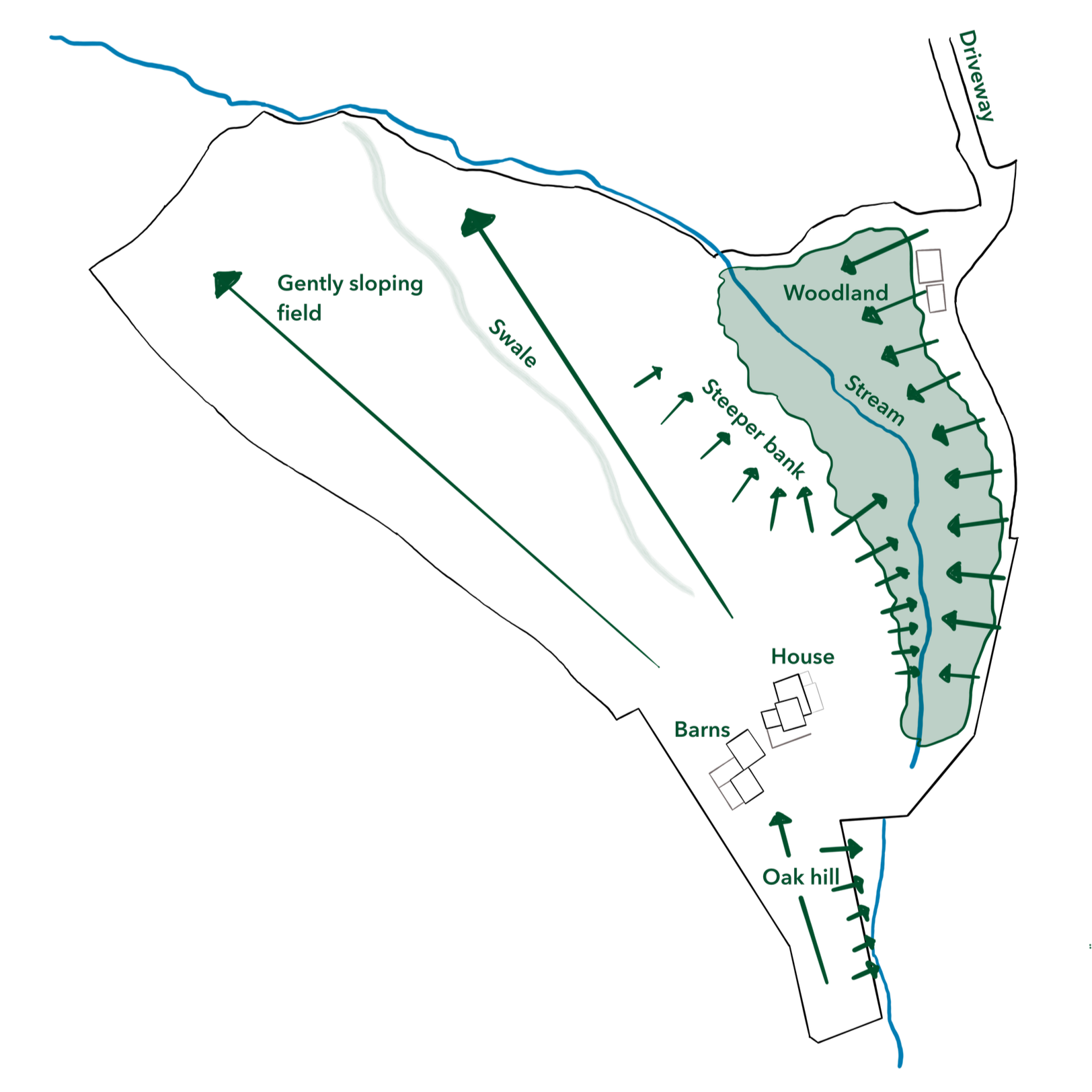
The land is varied in character. In front of the house towards the southwest, around four acres of gently sloping open grassland are divided by an undulating swale. This land falls off more steeply to the north, dipping down towards a stream that flows through a couple of acres of woodland, before rising rapidly once more towards the surrounding hills. Behind the house to the east, another acre of fairly steep, overgrown land is dominated by an ancient, veteranising oak tree. To the south of the house, there are two old stone barns, beyond which lies a further small area of open ground.
The brief
Cwmamliw is as much a way of life as it is a project. We have a deep-seated need to create, and Cwmamliw is how we have chosen to meet that need. We want to create a place of extraordinary beauty and interest: somewhere we love being, that rewards exploration, and that becomes richer and more distinctive as it develops. We want it to feel as though it belongs to its setting, but without simply reproducing the landscape around it, and to work with the land rather than against it.
A key element of Cwmamliw is time. We do not have the resources to quickly transform the landscape with extensive groundworks, large machinery and mature plants; and we wouldn’t want to do this if we had. We want to create and maintain the landscape ourselves; to take pleasure in seeing it change through our own hard work, and to enjoy the process of growing plants from seeds and cuttings and watching these slowly build a beautiful garden.
Plants are another critical part of Cwmamliw, which is at least as much a plant collection as it is a garden. We want a diverse range of plants, but these need to come together into a coherent whole. It is not a botanical collection; each plant needs to earn its place, whether through its form, foliage, flower, fruit, fragrance, autumn colour, winter interest, or some other quality that makes it worth having.
Cwmamliw needs to be maintainable by just the two of us, with occasional voluntary support from friends and family. This will have a significant influence on the character of the landscape. Many of the common elements of traditional gardens will play at most a limited role. Lawns take more time to maintain than we have available, as do carefully clipped hedges, and formal herbaceous borders.
Instead, we will make extensive use of woody plants, which we can allow to develop with relatively little intervention over time. These will help create both the structure of the landscape and its character. We will selectively prune the trees to keep the planting open and allow light to reach the ground, so that a ground layer of tough perennials and annuals can thrive beneath them. In the more open areas of the landscape, we will borrow from naturalistic and ecological approaches to planting, using plants that can compete and establish with relatively little intervention. This should make maintenance more manageable, while still allowing us to create the particular character we want for the garden.
Cwmamliw should be a place to explore, but also somewhere to live. There will be places to sit and reflect, places to entertain, and destinations to visit. Routes through the garden will bring the wider landscape into the overall experience, with views across the valley towards the mountains; but smaller paths will also encourage meandering, allowing a more intimate experience of the landscape.
We are not trying to create the finished Cwmamliw. We will be working on it for decades, deliberately creating a succession of landscapes, each providing the conditions for the next. We will continue to make decisions, see what happens, and change course when experience shows that we should. Cwmamliw will never be finished.